Nicholas Tana
My journey into horror began exactly how mine was meant to: with a clunky camcorder, a generous squirt of ketchup for blood, and the wide-eyed ambition of two teenagers convinced they could conjure terror in a dilapidated Colonial house. That raw, chaotic, and imaginative style of filmmaking was pure passion. It was messy, maddening, and fun.
Filmmaking has always had diverse beginnings—from early reels to digital rigs—but for an art form barely a century old, it’s already showing signs of decay. Its mortality is a horror story in itself. We grew up on this medium, and while we may have already seen its golden age, the true villain isn’t the audience’s attention span—it’s the corporate structure that has claimed its soul.

Years later, after navigating the corporate world in roles ranging from a PBS intern to Associate Director at ESPN, I quit to start my own production company.
My foray into scripted horror became Hell’s Kitty—the web-series-turned-cult-film about a horror writer and his possessed, very possessive cat.
To make it viable, I had to master a new kind of survival: cobbling together episodes into a feature, attracting big-name talent, and adapting the story across media—from comic books to a sold-out stage musical.
But as the fickle movie industry continued to rot—the death of DVD, the rise of gaming, and the pandemic pushing an already dwindling audience out of theaters—I survived by consulting as an IT project manager, technical writer, and instructional designer. My clients ranged from major tech firms like Cisco and Amgen to entertainment giants like Disney, Fox, and the NFL Network. I learned to create what the industry calls “industrials” just to stay alive.
What I didn’t realize then was that the most terrifying monsters weren’t only lurking on chaotic film sets—they were sitting in corner offices, too.
The Audition of the Icons and the B-Movie Bureaucracy
My perspective shifted after working with horror royalty. In making Hell’s Kitty, I had the surreal privilege of collaborating with genre legends like Michael Berryman (The Hills Have Eyes), Adrienne Barbeau (The Fog), and Doug Jones (The Shape of Water).
They joined because they recognized the originality of the web-series medium and my meta-comedic approach—celebrating the very archetypes that made them icons. Like the genre itself, they understood that horror never truly dies—it just keeps coming back in new forms.
Behind-The-Scenes From the comedy-horror Hell’s Kitty.


It took over four years to shoot the first season entirely in my 1920’s Koreatown apartment. I had to rewrite scripts constantly to match each actor’s availability and the persona they were parodying. Rather than seeing these constraints as obstacles, I treated them as opportunities to learn and adapt, which turned the entire process into an exercise in creative resourcefulness.
This approach allowed the franchise to grow organically across numerous platforms. Each medium served a different narrative function: the web-series introduced the world; the feature film unveiled the ending and how the conflict resolves; the comic book filled in the “u-turn” arc, detailing what happened to the central antagonist (my cat Angel) after she runs away in one episode; and the musical traced the origin story of the spirit possessing my cat.
I wasn’t just telling a story—I was building a universe on a micro-budget. That’s real creativity. Still, I wasn’t making enough to live on. The amount Amazon paid filmmakers for streaming dropped by more than half between my 2016 release of Sticky: A (Self) Love Story and 2018’s Hell’s Kitty.
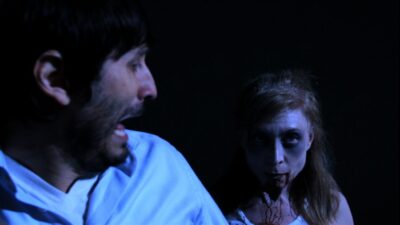
From possessed cats to porn stars playing zombies, Hell’s Kitty has it all.
To stay afloat, I took on more corporate gigs—and soon realized the grim parallels between the entertainment industry and the modern workplace. This gave me a unique perspective: the same survival skills required in a zombie apocalypse—resourcefulness, adaptability, imagination, and keeping your humanity intact—are, in fact, the essential rules for thriving in business, life, and every field from education to entertainment.
The Hollywood Myth vs. The Perpetual Hustle
Everything today is corporate—especially Hollywood. Many creatives still cling to the fantasy of “making it,” of quitting the day job to live entirely off their art. But for most, that’s just a myth.
While I spent two years living solely off creative projects, most of my career has been a balancing act—a perpetual hustle. It meant multiple income streams: rental property, stock investments, freelance contracts, consulting gigs. The person who claims to be a “full-time filmmaker” often just has the best side hustle—or the best poker face.
This necessity for financial agility isn’t failure; it’s survival. It’s the essential skill in a business built on over-promising and under-delivering.
The Corporate Zombie Apocalypse Is Real
What did I see when I peered into the boardrooms and cubicles of the studios deciding what gets made? A horde of Corporate Zombies.
These entities—let’s be honest—have swallowed most of Hollywood’s creative output. They’re slow, risk-averse beasts whose goal isn’t creation but survival through maintenance. They thrive on bureaucracy, feeding on the energy of creatives while draining innovation dry. Every decision is based on analytics, pre-tested IP, and a pathological fear of original thought.
And now, as the mobsters who once controlled parts of the unions and laundered money through Hollywood’s chaotic system are being arrested or forced out, a new breed of monster has taken over: the tech mogul. The result is mixed. While there are a lot less sexual harassments, and deals done behind-closed-doors; it’s only getting more corporate, more risk averse, less original—and far less human. If you’re not too worried about earning all your money back, you can take more risks after all.
Now the stress of making a movie is immense—but the anxiety of navigating a corporate world that feels like a post-apocalyptic wasteland of recycled ideas and brain-dead procedures? That’s the real horror show.
That realization inspired CorporateZombieSurvival.com—a blog dedicated to teaching modern professionals how to evolve before the office consumes them.

Filmmaking: The Walking Dead?
Here’s the most unsettling thought of all: filmmaking itself may already be one of the walking dead.
The old ways of storytelling—theatrical releases, giant budgets, and the sacred three-act structure—are decomposing. The endless remakes, sequels, and cinematic universes are just zombies feeding on familiar flesh.
Meanwhile, new forms are mutating faster than a ghoul’s bite: short-form video, XR experiences, interactive stories, and content for the screens that fit in our hands. Using free tools like DaVinci Resolve and Blender, and shooting 4K on a glorified phone, isn’t a compromise—it’s evolution. The same can be said of using AI.
We will inevitably have to evolve how we tell stories as the medium changes. It’s a matter of keeping the ideation, the imagination, the very magic, human.
How Can Storytellers Survive Filmmaking Apocalypse?
To survive the Corporate Zombie Apocalypse, whether in a cubicle or on an indie set, the rules are the same:
- Keep Moving: Stay adaptable. Keep learning, evolving, and embracing chaos—or obsolescence will find you.
- Find a Tribe: Creativity is survival. Build a loyal team of collaborators who lift you up and share your vision.
- Stay Human: Zombies aren’t creative—they consume creativity. Our messy, beautiful humanity is our only defense. We can’t wait for the studio or the system to save us—the system is already decomposing.
In essence, we must master every piece of the creative process, from script to digital distribution. If we don’t evolve, the curtain won’t fall with a scream, but with the cold, hollow silence of corporate takeover. The ability to imagine and tell stories helps keep us conscious, creative, and human, no matter how the tools we use evolve. It is when we stop doing this altogether—when we allow the tools to replace the imagination, rather than serve it—that we become one of the living dead.
So go forth and start your evolution. Your next nightmare—and your professional survival—depends on it. Remember, it’s always better to control your story than be consumed by it.